FIRST TEAM
ALL OUR YESTERDAYS: HAPPY BIRTHDAY TO US!
As the club prepares to turn 150 years old, Kingsley Hyland’s regular series of rugby reminiscences assumes added significance.
1976(77) AND ALL THAT
Part 1
In September or October 2027, exact date unknown, the rugby club now known as Newcastle Red Bulls celebrated or will celebrate its 150th birthday.
For much of its early life Gosforth Football Club, as it was initially known, was what would now be considered a ‘community’ club, playing matches almost exclusively against local opposition. But all that changed in the last two decades before its 100th birthday.
A steadily improving fixture list saw the club usurp Northern’s position as Northumberland’s top club, and their domination of the Northumberland County Cup guaranteed their invitation to participate in the fledging National Knockout Cup – later the John Player Cup – in the early 1970s.
Many thought that Gosforth’s rise to the highest echelons of English club rugby had reached its pinnacle in April 1976 with victory over Waterloo in the cup final at Twickenham. Just six of 42 matches were lost in that 1975-76 season, and few believed that that record would be beaten with the increased call on the top players from the County Championship and the Five Nations and the departure to Bath of talismanic coach Jack Rowell.
Remarkably, in their 100th season, 1976-77, the club topped those achievements. In addition to retaining the John Player Cup they won the inaugural RFU Merit Table, the Sunday Telegraph Pennant, the Journal Trophy, the Northumberland Senior Cup and reached the final of the prestigious Middlesex Sevens.
Over the course of this season in a series of articles we will look back 50 years and chronicle the major events of that record breaking campaign, in which only two of 36 matches were lost – by far the club’s most successful season in the pre-1995 amateur era. We will highlight some of the club’s major personalities from that time, explore how much the game has changed in the intervening 50 years and look at some of the challenges facing the senior club game - not all of which have been overcome even now.
PART 1: AUGUST – SEPTEMBER 1976
August 1976
In the days before rugby union became open in 1995 English club rugby could only be played between September and April. Any fixtures outside this period required RFU approval, which could not be guaranteed. Rather like 2026, the summer of 1976 had been unusually hot and dry, and as clubs began to wind down their pre-season preparations most of the country was experiencing severe drought restrictions with standpipes providing running water to many of the towns and cities. In late August the RFU Secretary, Bob Weighill, wrote to the English clubs advising them to consider cancelling fixtures where pitches lacked a good covering of grass and were hard. It was even suggested that clubs contact their local water authority to ask if they could provide water “that cannot be used for other purposes”. The advice it seems was largely ignored and the new season kicked off on scheduled at the beginning of September.
September 4, 1976
Gosforth kicked off their season with a home fixture against Edinburgh Wanderers. The club had a track record of starting the season slowly, and Wanderers were one of Scotland’s top club sides. The team showed six changes to that which had taken the field in the memorable John Player Cup final victory over Rosslyn Park in April but welcomed back Roger Uttley, who had missed the final courtesy of a broken leg sustained at Richmond in January. In the event the home side dominated every facet of the game in winning 56-9 (67-10 with today’s scoring method). They ran in 11 tries through Malcolm Young (2), Alan Robson (2), Peter Dixon (2), Stuart Archer, David Robinson, Uttley, Duncan Madsen and Harry Patrick. Young kicked three conversions and two penalties and managed to hit the post with two further attempts. The team for that opening fixture was as follows:
Brian Patrick; Sturt Archer; Harry Patrick; Roger Biggs; Alan Robson; David Johnson; Malcolm Young: Colin White; Duncan Madsen; Andy Cutter; John Hedley; John Short; Peter Dixon; Dave Robinson; Roger Uttley (capt).
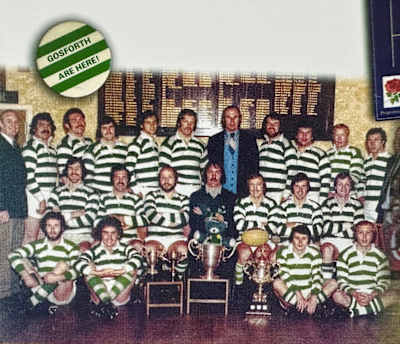
The Gosforth squad of 1976
© NRB
Photo caption: The Gosforth squad with the John Player and Northumberland Senior Cups secured in April 1976 and which they would be defending in 1976-77. Skipper Roger Uttley [middle row, centre] missed the finals due to injury. Coach Jack Rowell [back row, 7th from left] left the club in the summer but went on to enjoy considerable success as coach of Bath and England.
The local rugby season had already started four days earlier at Tynedale. Tynedale were a year ahead of Gosforth in celebrating their Centenary and kicked off the celebrations with an attractive home fixture against Hawick in which the Borders side came out on top 19-9.
Three days after the Edinburgh Wanderers match it was reported that the club’s long serving hooker Duncan Madsen had announced his retirement from international rugby citing ‘business reasons’ – he was a practising solicitor at the time and it would be some years before he embarked upon his second career as a rugby writer on the Newcastle Evening Chronicle. At the time of the announcement he had been capped nine times by Scotland. He made his international debut in the Five Nations (as was) in February 1975 at Murrayfield against Ireland and went on to play four tests against the All Blacks in New Zealand that summer. His retirement turned out to be relatively short lived as he returned to play in all four of the 1977 Five Nations before bookending his international career against Ireland in Dublin in January 1978.
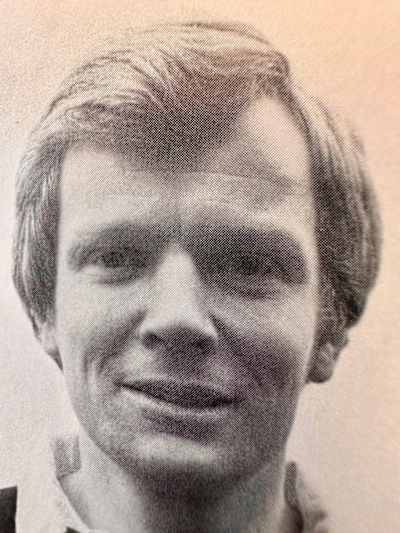
Duncan Madsen
© NRB
September 11, 1976
Gosforth’s next outing was at home to Liverpool on September 11. Liverpool were one of only six teams to beat Gosforth in 1975-76, albeit at Liverpool. The match was played in awful conditions with driving rain and a challenging wind in front of selectors from both England and Scotland. Gosforth won 31-0. Young again led the way with three tries to add to his brace the previous week, four conversions and a penalty for a personal tally of 23 points. The other points came from two Roger Biggs tries.
An indication of the challenges that the Gosforth selectors would face when the County Championship kicked off in October became clear when Northumberland announced their provisional squad. It contained 15 Gosforth players including three fly-halves – Richard Breaakey, his brother Nigel and Willie Stephenson. 24 hours later Durham announced their provisional squad with five Gosforth players, some of whom had already been selected by Northumberland!
September 18, 1976
Having seemingly overcome their traditional early season difficulties in scoring 77 points and conceding just nine the tin two matches, the team travelled north full of confidence to face West of Scotland. This would prove to be their most challenging encounter so far as they needed a late Malcolm Young penalty to secure a 9-8 win. West’s points came from two unconverted tries, whilst all of the visitors’ points came from the boot with David Johnson – a fly-half overlooked by the county selectors – kicking a drop goal to add to Young’s two penalties.
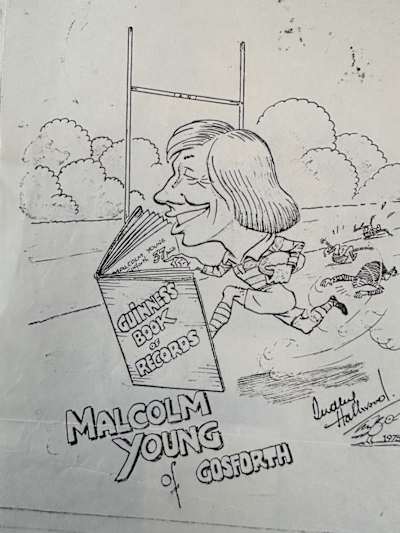
Malcolm Young
© NRB
Photo caption: Malcolm Young appeared in a caricature by local cartoonist Dudley Hallwood after scoring what was then a world record 37 points in a single match when playing for Gosforth in a club game against Waterloo.
Apart from the National Knockout Cup, now sponsored by John Player, which had launched in 1971, there were no national club competitions in England. Formal leagues were still more than a decade away. The RFU jealously guarded its County Championship as the key stepping stone between club and international rugby, and had long resisted any move towards a formal clubs league structure. But the tide was beginning to turn as the major clubs pressed for some form of inter-club competitive structure. The RFU had last given its approval – if not its blessing – for proposed regional merit tables.
These would not be leagues as such as clubs would not all play each other. Clubs were still free to organise their own fixtures and choose who they wanted to play against and when and where they wanted to play them. Positions in the merit tables would be determined by win percentages. In theory, therefore, a team that won 19 matches out of 20 could finish below a team that won 7 out of 7. The criteria relied upon by the RFU to determine which clubs would be invited to participate in the tables were somewhat opaque, but the following clubs were invited to form the first Northern Merit Table: Birkenhead Park, Bradford,Broughton Park, Fylde, Gosforth, Halifax, Harrogate, Headingley, Liverpool, Northern, Orrell, Sale, Roundhay, Wakefield, Waterloo, Wilmslow.
Of those clubs only Fylde, Gosforth (as Newcastle Red Bulls), Harrogate, Headingley/Roundhay (as Leeds Tykes) and Sale are still playing in the top four divisions of the club pyramid. Northern were perhaps a little fortunate to make the cut in a table which contained no Durham club, with both senior Hartlepool clubs, West and Rovers, overlooked.
September 20, 1976
County rugby still held sway and an experimental Northumberland XV including the Patrick brothers, Roger Biggs, Nigel Breakey, Colin White, Duncan Madsen and John Short from Gosforth lost 13-21 away to Edinburgh and District in a warm-up for the impending County Championship season, in which Northumberland would be required to play Durham, Yorkshire, Lancashire, Cheshire and Cumbria.
September 25, 1976
Gosforth rounded off the season’s opening month with a trip to Broughton Park. They travelled with a much-depleted team. Internationals Roger Uttley and Peter Dixon and future international Colin White were missing through injury whilst John Hedley, Terry Roberts, Bon Anderson and Alan Robson had been selected by Durham for their Centenary Match against invitational team the Dolphins.
Broughton Park did in fact lead for most of the opening half with two penalties from full-back Kevin O’Brien to a Dave Robinson try, but a penalty from Young nudged the visitors 7-6 ahead at half-time. In what was to become something of a pattern as the season wore on Gosforth totally dominated the second half as their formidable pack gradually ground down their opponents. Young kicked two further penalties and Brian Patrick crossed for a try. Park’s only response was a third O’Brien penalty.
September 29, 1976
After the opening month of the season Gosforth were still missing several key players from their 1975-76 John Player Cup run. Nevertheless, they could boast a playing record of: Played 4, Won 4, Drawn 0, Lost 0. Points for: 113. Points against: 26.
On the final Wednesday of the month they the club’s second string, the Greyhounds, travelled to play a Kelso XV under lights and were grateful to be able to field abrasive wing Steve Gustard, who was returning to the side having completed a suspension carried over from the previous season. A strong Greyhounds side were comfortable 38-13 winners.


