Home
ALL OUR YESTERDAYS: OUR FRIENDS IN THE NORTH
As Newcastle Red Bulls and Sale Sharks prepare for Saturday’s northern ‘derby’, Kingsley Hyland’s series of rugby reminiscences focuses on club rugby at the upper end of the country.
For the purposes of promoting its own brand, Prem RUGBY often refers to the Newcastle v Sale fixture as a ‘local derby’ notwithstanding the 153-mile distance between Kingston Park and Corpacq Stadium.
No amount of self-promotion can hide the fact that league rugby, first introduced in England in 1987, has not been kind to the northern-based clubs, and it has been left to Newcastle and Sale to carry the torch for the north as the PREM’s sole representatives north of Leicester since 2011. Even in that period Sale have twice been left to go it alone following Newcastle’s relegations in 2012 and 2019.
Sale have dominated this fixture in recent seasons, winning the last six matches, dating back to 2023. Newcastle’s last victory came two days before Christmas 2023 when they triumphed 20-14 at Kingston Park.
There have, however, been periods when Newcastle have dominated the fixture, for example winning six consecutive matches between 1993 and 2000. In fact, taken over the 39 seasons of formal league rugby, Newcastle have had slightly the better of the fixture with 29 wins to Sale’s 27, with three matches drawn.
The stats, for what they are worth, suggest that Newcastle have been better at raising their game when playing their ‘local’ rivals as, despite that marginally better record, Newcastle have finished below Sale in the league table in 18 of the 31 seasons that the two clubs have played in the same league. Inevitably, Newcastle and Sale remain the only northern clubs to have won the PREM in its various guises.
Sale were Newcastle Gosforth’s first league opponents when the club moved to Kingston Park in 1990, Newcastle winning 7-6.
That was an important victory for the club. With a new ground, a new name and their first full-time director of rugby, it was vital that they got off to a good start in their new surroundings following their deeply disappointing season in exile at Percy Park where, ironically, their only league victory all season came against Sale in the penultimate home league fixture (22-18).
SEPTEMBER 22, 1990 – NEWCASTLE GOSFORTH 7-6 SALE
Victory in the first league match under the stewardship of new director of rugby, Mike Mahoney, was founded on a strong defensive performance which shut out Sale until the dying minutes. Improved defence throughout that season was the clearest evidence of Mahoney’s influence. As Gosforth they had conceded 724 points in 1989-90, compared to the 468 points they were eventually concede in 1990-91.
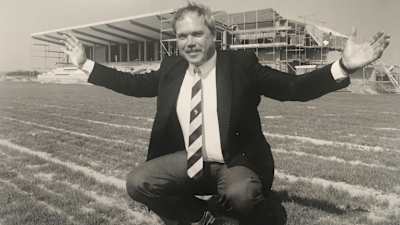
Mick Mahoney
© NRB
Despite the presence of former British and Irish Lion Steve Bainbridge in the second row the lineout struggled, the referee seemingly unaware that lifting in the lineout had not yet been legalised. The front row were also given a hard time. The game remained scoreless at half-time which suited Newcastle, as they had been playing into a strong wind.
Wind has always been a factor at Kingston Park, even more so prior to the construction of the West Stand in 2002. Newcastle presented much the greater threat with the wind behind them, benefiting from fly-half David Johnson’s astute tactical kicking and some effective breaks in the centre from Ross Wilkinson and Paul Holdstock.
Their sole try came from quick ruck ball after both Wilkinson and Holdstock had punched holes in the Sale rearguard, which allowed Johnson to send in full-back Jonathan Whisker on the blindside. Johnson missed with the conversion attempt but was successful with a penalty on 71 minutes which effectively made the game safe.
With the clock ticking Sale finally burst into life. Newcastle missed touch with a clearance kick, allowing Sale fly-half Phil Jee to run the ball back, and when he chipped over the rushing defensive line he was taken out by Holdstock, resulting in the award of a penalty try. Richard Booth added the conversion, but that was the end of the scoring.
The Newcastle Gosforth team that day was: J.Whisker; G.Spearman; P.Holdstock; R.Wilkinson; M.Winham; D.Johnson; S.Douglas (rep. C.Henderson 46); P.Fraser; N.Frankland; I.Shanks; T.Roberts (capt); S.Bainbridge; J.Baldwin; S.Byrne; B.Chick
In a sign of the major player turnover that resulted from the move to Kingston Park only Graeme Spearman, Ross Wilkinson, Mark Fraser, Neil Frankland, Terry Roberts and Brian Chick had played in the corresponding fixture at Percy Park barely six months earlier.
Why has league rugby proved so challenging in the north in the league era?
The Rugby Football Union has always been an extremely conservative body and fought long losing battles against the introduction of leagues – which were not formally recognised until 1987 – and later against professionalism in 1995. In the latter case they even proposed a year long moratorium prohibiting payments to players in England even after World Rugby declared rugby union open.
They only resiled from this position when threatened with legal action for restraint of trade. As a result, many of the top rugby union players in the north were still being enticed away to rugby league, where they could be paid for playing without having to relocate. The roles would later be reversed as fresh investment enabled the richer union clubs to pick off the best of the rugby league talent from its heartland in the M62 corridor.
More pertinently, none of the top north-based rugby union clubs at the time were attracting big gates, unlike their peers in the midlands and south west. Northern clubs were therefore more dependent on investors to be able to compete with their wealthier rivals further south and so it is perhaps not surprising that Newcastle and Sale have survived at the top level as they have both had a series of investors who have stayed the course – in Newcastle’s case Sir John Hall, Dave Thompson, Semore Kurdi and now Red Bull. The club would not have survived at the top level had any of these investors just walked away.
Prior to the introduction of leagues clubs were responsible for organising their own fixtures, which they had to negotiate with the clubs they wanted to play against. Without formal RFU endorsement the four RFU divisions – North, Midlands, South and South West and London - formed internal merit tables involving their so-called senior clubs.
The merit tables were based on results between clubs in the table which the clubs had organised themselves. That meant that there was a massive imbalance in the number of fixtures played by each club, and it was certainly not a case where every club played every other club. The only stipulation was that to qualify each club had to play a minimum number of matches against other teams in the table. Placings in the table were determined by win percentages, so for example a team that played and won 8 qualifying matches would finish higher in the table than a team who won 14 out of 15 matches.
The first sign of the RFU relaxing its position came in 1986. Writing in Rothmans Rugby Yearbook for that season, the Guardian’s David Frost said:“In the course of the season, the RFU allowed 24 leading clubs to split themselves into two national merit tables. It cannot be satisfactory to have a competition in which not every club plays every other club in its table. What English rugby badly needs is a proper system of club leagues in which every club plays every other club in its league. That is the only test of true merit. When England gets a system of club leagues, feeding through to the new Divisional Championship, England’s performances at international level will surely improve.”
He did not have to wait long to get his wish, with the introduction of leagues at the start of the 1987-88 season. Farcically, the divisional merit tables continued to operate alongside the national merit tables so that, for example, when Gosforth played Waterloo the result counted in both the National Merit Table and the Northern Merit Table.
For the record, the teams making up the 1984-85 Northern Merit Table were Broughton Park, Fylde, Gosforth, Hartlepool Rovers, Headingley, Liverpool St Helens, Morley, Orrell, Roundhay, Sale, Sheffield, Vale of Lune, Wakefield, Waterloo and West Hartlepool. Of these 15 clubs only Gosforth (as Newcastle Red Bulls), Headingley (as Leeds) and Sale are still operating in the top three divisions of the RFU leagues.
The teams forming the new National Merit Tables were:
MERIT TABLE A: Bath, Bristol, Coventry, Gloucester, Harlequins, Leicester, London Scottish, Moseley, Orrell, Sale, Wasps.
MERIT TABLE B: Blackheath, Gosforth, Headingley, London Irish, London Welsh, Liverpool St Helens, Northampton, Richmond, Rosslyn Park, Saracens, Waterloo.
Despite the RFU’s reluctance to recognise merit tables they did play a significant part in determining where clubs would be placed when the leagues began in 1987.
NATIONAL DIVISION ONE: Bath, Bristol, Coventry, Gloucester, Harlequins, Leicester, Moseley, Nottingham, Orrell, Sale, Waterloo, Wasps.
NATIONAL DIVISION TWO: Bedford, Blackheath, Gosforth, Headingley, Liverpool St Helens, London Irish, London Scottish, London Welsh, Northampton, Richmond, Rosslyn Park, Saracens.
The league tables at the end of that first season of league rugby looked like this.
NATIONAL LEAGUE 1
Leicester
Wasps
Harlequins
Bath
Gloucester
Orrell
Moseley
Nottingham
Bristol
Waterloo
Coventry (R)
Sale (R)
NATIONAL LEAGUE 2
Rosslyn Park
Liverpool St Helens
Saracens
Headingley
Bedford
Richmond
London Scottish
London Irish
London Welsh
Gosforth
Blackheath
Northampton
The professional limbs of Wasps and London Irish no longer exist, although both have stated an intention to re-form and compete at the highest level possible. At one point London Irish, London Scottish and Richmond merged to form one club playing at Reading but when their investor, Monaco-based Ashley Levett, withdrew, they went into liquidation. The three original clubs re-constituted themselves as separate entities and worked their way back up from the bottom of the RFU clubs pyramid.
So when the league system commenced operation in 1997 the north had three representatives out of the 11 clubs in the top tier, but Sale were relegated at the end of that season and Waterloo followed the following season along with Liverpool St Helens, who had been promoted from Division 2 at the end of 1987-88.
Waterloo have never returned to the top tier, although Liverpool St Helens did return after just one season only to suffer immediate relegation, and they too have never made it back to the top. Sale did not regain their place at the top table until 1994 when they replaced Newcastle Gosforth, who survived just one season in Division 1. To their immense credit Sale have remained at the top since 1994 lifting the Premiership title in 2006.
Newcastle finally regained their top tier status in 1997 and immediately proceeded to win the title in 1998. They have remained at the top ever since, save for seasons in the Championship – the old Division 2 – in 2012-13 and 2019-20.
The first 15 seasons of league rugby in England were dominated by Leicester and Bath, who between them won 13 of the titles on offer. Only Wasps (1996-7) and Newcastle (1997-98) managed to buck the trend.
Whilst the other northern teams suffered relegation at one time or another, Orrell enjoyed some success in the top division in the early years, surviving relatively comfortably and finishing 2nd in 1991-92, just a point behind champions Bath. Professionalism did not work out for them. They were taken over by Dave Whelan of DW Sports and merged with Wigan Rugby League Club, but after that fell through they were relegated at the end of the 1996-97 season and began a gradual plunge down the leagues.
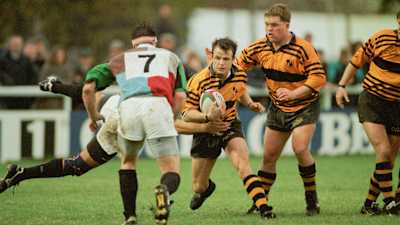
Orrell's Austin Healey
© Getty Images
The only other northern clubs to have featured in the top league are West Hartlepool, Leeds in their various guises and Rotherham. West Hartlepool first made it to Division 1 in 1992 but lasted only one season before being relegated, swapping places with Newcastle Gosforth, who also only lasted one season. Roles were reversed the following season as West secured an immediate return to the top, replacing relegated Newcastle Gosforth.
They managed to survive for three seasons this time until their relegation at the end of the 1996-97 season. They returned in 1998 for just one season before they too began a gradual slide down the pyramid after their financial backer pulled out. The 1998-99 season was the only season in which Newcastle and West faced each other in the Premiership in what could legitimately be considered a ‘local derby’. The Falcons won both matches, 24-12 at Hartlepool United’s Victoria Park ground and 29-13 at Kingston Park.
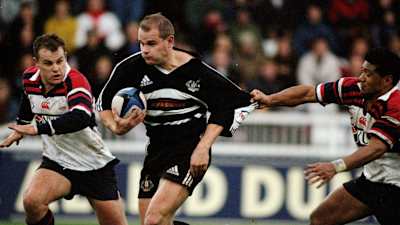
Newcastle against West Hartlepool
© Getty Images
Rotherham did not fare well in what by now had become the Premiership. In their first season (2000-01) they managed just two wins out of 22 and were relegated. They returned in 2003-04 but lost every match, and were again relegated. They too slipped down the leagues before working their way back up, and have just secured promotion back to the Championship.
Leeds fared rather better and managed a total of seven seasons in the Premiership. They finished bottom in their first season (2001-02) but avoided relegation as a result of an expansion to the league. They finished 5th in 2002-03, 11th in 2003-04 and 8th in 2004-05 but were relegated at the end of the 2005-06 season. They returned 12 months later only to suffer immediate relegation, and they met the same fate in 2010-11. It is therefore 15 years since England’s largest county, with its 110 rugby clubs, had a team in the top tier of English rugby.
It is not just in the league that the northern clubs have struggled. The National Knockout Cup ran as a truly national club competition between 1972 and 2005 but only two northern clubs ever won the competition.
Newcastle won the cup on four occasions – only Bath and Leicester won it more times – in 1976 and 1977 as Gosforth and 2001 and 2004 as Newcastle Falcons.
They were beaten finalists in 1981 and 1999. Leeds were the last winners of the competition, beating Bath 20-12 in 2005. Sale were beaten finalists in 1997 and 2004, and Waterloo were the Gosforth’s victims in 1977.
The 1977 and 2004 finals were all-northern affairs, but in 1978-79 no northern club managed to reach the quarter-final, whilst in 1985-86 and 1989-90 no northern managed to get past Round 4.
READ MORE