Home
ALL OUR YESTERDAYS: NEWCASTLE’S FORGOTTEN INTERNATIONALS
Kingsley Hyland’s regular stroll through the club archives focuses on a number of Gosforth greats, who can now officially be classed as full international rugby players.
To much fanfare the RFU recently announced that it would retrospectively award full England caps to 47 former players who had represented their country at senior level at various times between 1945 and 1993, in matches which were not at the time regarded as full internationals.
Announcing the retrospective awards, RFU President Rob Udwin stated: “These players represented England with distinction, often in challenging post-war circumstances or on demanding overseas tours. They wore the rose, faced full international opposition and demonstrated the same pride and commitment as any fully-capped England player. It is only right that we formally acknowledge their achievements. These caps are a long-overdue honour, and we look forward to celebrating these individuals and their families as we place their names into the permanent history of English rugby.”
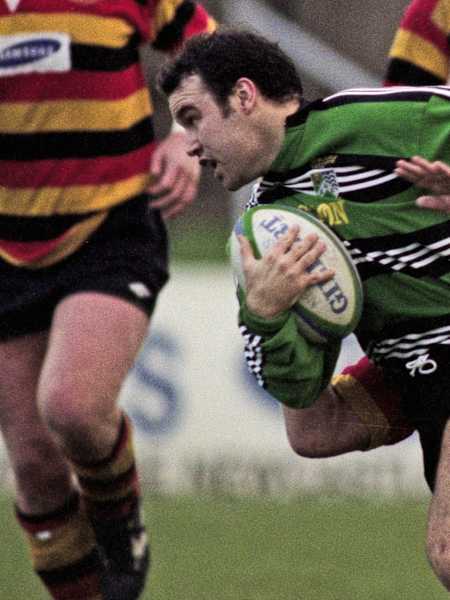
It is likely that the only name on the list recognisable to the current generation of Newcastle supporters will be that of current academy and pathways director, John Fletcher (pictured above).
Whilst Fletch has had a long association with the club it was as a Tynedale player that he represented England against Canada in 1993, in a match won by England 19-14. His playing involvement with the club was only fleeting, but the same could not be said of five other names appearing on the list of 47 who represented the club in its time as Gosforth.
The club was less than 20 years old when George ‘Tot’ Robinson became the club’s first international player, representing England on the wing against Ireland at Landsdowne Road in February 1897. It was almost 23 years later when Alastair Smallwood made his international debut against France at Twickenham. Whilst Arthur Smith was capped by Scotland in 1955 and Ray McLoughlin by Ireland in 1962, it would not be until the 1970s when Gosforth’s hard-won status as one of the country’s top clubs was reflected in terms of international recognition.
Between 1971 and 1983 Peter Dixon, Roger Uttley, Malcolm Young and Colin White made their England debuts whilst Duncan Madsen, Richard Breakey and current Northern President Jim Pollock were capped by Scotland. Dixon and Uttley would also represent the British and Irish Lions with distinction.
Having produced just nine full internationals in the first 100 years of the club’s existence, it was a reflection of the club’s status and a source of great pride when the 1977 Calcutta Cup match at Twickenham featured four of the club’s players. By then Dixon and Uttley were established internationals, and they joined by Malcolm Young making his England debut at scrum-half and Duncan Madsen packing down at hooker for the Scots.
The club never again reached the heights of 1977 in the amateur era but did make it through to their third National Knockout Cup Final in 1981. Young and White, who was capped in 1983, played in that final but Dixon, Uttley and Madsen had either moved or retired. Four of the players who also played in that match – Jeff Bell, Alan McMillan, Neil McDowell and John Butler - are represented on the list of 47 as is club legend Dave Robinson, who along with Dixon and Uttley made up a formidable back-row combination in the 1970s.
Sadly, club records from this period are surprisingly sparse. Alan Livingstone McMillan came relatively late to senior rugby when he joined Gosforth aged 28 in 1979, having previously played for Seghill, Morpeth and Ruthin in North Wales. He represented England on the 1979 tour to Japan, Fiji and Tonga. He was one of three try scorers in the club’s 1981 24-3 cup semi-final victory over Moseley. During his time at the club he was working as a nuclear engineer at the Central Electricity Generating Board at Hartlepool.
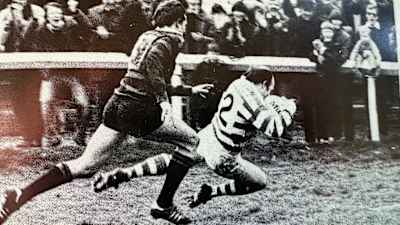
Alan McMillan
© NRB
Jeffrey Alan Helmut Bell (aka ‘Crazy Horse) was a native of Middlesbrough who joined the club as a 22-year-old prop forward in 1977. He had represented England Under-23s whilst at Middlesbrough but his retrospective cap rewards his appearance for the senior side against the USA at Twickenham in October 1977.
The USA had played at the club the previous weekend, and such was the strength of Gosforth at that time that they defeated the tourists 18-12. Although there was a big drinking culture in rugby at the time, Jeff’s post-match tipple of choice was a bottle of milk. A playing colleague recalls that at the end of one season he chucked his kit bag into a corner without emptying it. He was not exactly popular with team-mates when he next emptied it at the commencement of pre-season training at the height of summer, as he had forgotten that he had left a pack of parmesan cheese in said kit bag. Jeff is also remembered for playing in white boots.
John Lowther Butler was an athletic No.8 or second row from Egremont. A proud Cumbrian, he captained his county and joined Gosforth aged 24 in 1978, the first of many Cumbrians ‘recruited’ by Dave Robinson.
He represented England B against Romania in 1978 and reached the final England trial in 1979, and would probably have been capped in that year’s Five Nations had he not suffered the back injury which would eventually end his playing career. He was selected for the 1979 England tour to Japan, Fiji and Tonga alongside his team-mate Alan McMillan in a tour party that was captained by Bill Beaummont and included established internationals of the calibre of Dusty Hare, Peter Squires, Mike Slemen, John Carlton, Paul Dodge, Huw Davies, John Scott, Mike Rafter, Peter Wheeler, Colin Smart and Gary Pearce.
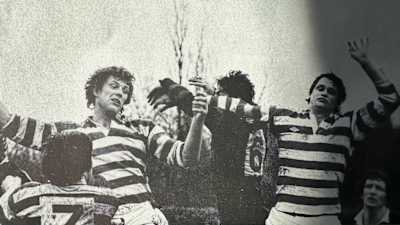
John Butler (right) and Steve Bainbridge
© NRB
John also played for the Barbarians that season. Sadly, a back injury ended his playing career at the age of 29 in 1983 . He was joint guest of honour at the club’s annual dinner that year alongside Iain Ramage, who had also been forced to retire through injury. John went on to become a highly respected coach of Cumbria for three seasons. He worked as a draughtsman at the Sellafield nuclear plant but died in 2023, having suffered from Parkinson’s disease for a number of years.
Neil Howard McDowell was another Cumbrian who was prevented from achieving his full potential due to injury. After starting his career at Cockermouth he arrived at Gosforth in 1978, aged 20, having spent the previous season at Tynedale. Primarily a centre, he played in every position in the back division during his time at the club. He played in the England trial in 1980-81 and was selected for the Under-23s, having been selected as a reserve scrum-half for the Under-19s in 1976. He is finally being recognised after his selection for the senior side on the 1982 tour to the USA and Canada.
If you were to be asked to produce a list of the club’s most influential players in the amateur era (1877- 1995) the name of Dave Robinson would appear towards the top, notwithstanding that he did not receive the recognition afforded to Dixon and Uttley.
Robbo’s contribution to the club as a player, captain and coach was immense, and he was undoubtedly one of the cornerstones of the side that won successive national cups in the 1970s. A Cumbrian hill farmer, he was persuaded by fellow Cumbrian Jimmy Hayton to join Gosforth in 1972 having previously played for Cockermouth, Carlisle and Birkenhead Park. He was club captain in the 1973-4 and 1974-5 seasons, a period of success in the two seasons immediately prior to the first of the John Player Cup wins.
In those two seasons the club played 77 matches of which they won 61, drew 6 and lost just 10, scoring 1,742 points and conceding 619. He played in both Twickenham cup-finals, scoring a try in the 1976 victory over Rosslyn Park and going one better with two in two minutes the following year in the defeat of Waterloo. His finest hour was probably his part in North-West Counties’ 16-14 defeat of the All Blacks at Workington in 1973.
After he finished playing Robbo coached the club in 1981-2 when they won 31 of 35 matches. He also became the club’s unofficial recruiting officer, identifying talented young players in Cumbria and persuading them to make the thrice-weekly journey across the A69 or military road to train and play for the club. In addition to John Butler and Neil McDowell (above) the production line of talented Cumbrians included Mark ‘Lennie’ Richardson, Mike Lowther, Paul Cusack, Mark McDowell, Paul ‘Kit Kat’ Bradbury and Steve ‘Tits’ Branthwaite.
Stories of Robbo’s off-field escapades whilst at the club abound, the most oft-told relating to an incident following a match at West of Scotland, highlights of which had been broadcast on Rugby Special.
The team had been invited to stay for a formal dinner at the host club’s high class franchised restaurant, which was also serving members of the public. West of Scotland’s international second row Gordon Brown was acting as a doorman, and it was a condition of entry that the players were wearing ties. Robbo, who was suitably dressed, had been seen disappearing into a field adjoining the ground. When he returned he was carrying a donkey which he carried up the stairs of the clubhouse to the restaurant, intending that the said donkey should join the players for their meal. Brown sought to bar the donkey’s entrance as it was not wearing a tie, but a tie was found and strung around the bemused beast’s neck. Sadly, the incident was not captured by the BBC2 cameras.
Now aged 80, Robbo, who had to overcome polio as a child, has suffered from declining mental health, which eventually forced him to surrender the tenancy of his farm. In November 2019 the Falcons hosted a dinner to raise funds for him, although he was not well enough to attend himself, and so was represented by his wife and daughters. John Butler and Neil McDowell were two of the main drivers behind that event, which received strong support from then-Falcons’ director of rugby Dean Richards. Deano had first encountered Robbo when he was part of the coaching team on England’s 1988 tour of Australia. He wrote of Robbo in the brochure produced for the fundraising dinner:
“However ‘old school’ Robbo may have been, he knew about people, hard people, and how to respect and earn respect. He was loved by all, he was one of the boys as well as one of the coaches, first to the bar, last to leave.”
The introduction to the dinner brochure asserted that “Robbo was undoubtedly one of the best, if not the best, English back-row forwards not to be capped by his country.” It is apt that this omission is finally being rectified.
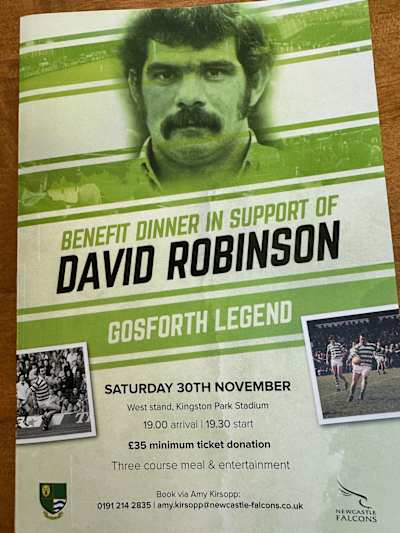
Programme for the David Robinson dinner
© NRB
John Fletcher grew up playing his rugby at Tynedale, making his first team debut aged 18 in 1979. He represented the England senior team on their summer tour to Canada in 1993. In September 1993 he joined Northampton. He was appointed as an RFU Development Officer in 1996. His time at Newcastle began in earnest in 2000 when he joined the coaching team at the Falcons’ Academy under Paul McKinnon, and then succeeded Paul as academy manager the following year.
During his tenure he nurtured talents such as Mathew Tait, Toby Flood and Geoff Parling, and helped establish the Academy as one of the most highly regarded in the country. In 2006 he was appointed director of rugby following Rob Andrew’s departure to the RFU. He was released in 2008 and subsequently headed up the RFU’s Under 18s programme along with Peter Walton. More recently he served as the head of pathway at the Scottish Rugby Union before becoming one of the first appointments of the Red Bulls’ era at Kingston Park when he was announced as academy and pathway director at the end of last year.
READ MORE